

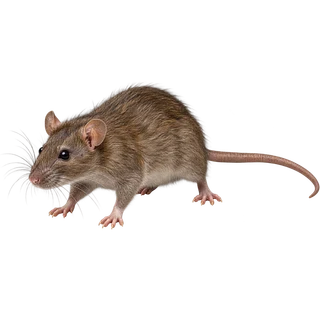
Rats & Mice
Rodents follow food and shelter. Glue traps deal with the ones inside without bringing poison into the house.

How to identify it
- Size
- House mouse 7 to 10 cm body, brown rat 20 to 25 cm body plus tail
- Colour
- Grey to brown, paler underneath
Droppings along walls, gnaw marks on packaging and cable, greasy smear marks where they run the same route repeatedly, and noise in ceilings or cavities at night.
How it behaves
Neophobic, meaning they avoid anything new in a familiar space, so results are rarely immediate. They run the same routes along walls and skirting rather than crossing open floor, and they are most active at night.
Where it breeds
Nests in wall voids, ceilings, behind appliances, in stored cartons and in outdoor rubbish. Breeding is fast and continuous where food is reliable.
Why it matters
Contamination of food and surfaces, damage to packaging, and gnawed electrical cable which is a genuine fire risk. Droppings and urine contaminate far more food than is actually eaten.
Costs nothing
Prevention first
-
01
Seal gaps. A mouse passes through a hole the width of a pencil.
-
02
Store food, including pet food, in hard sealed containers rather than sacks.
-
03
Clear stacked cartons and clutter, which is nesting material as much as cover.
-
04
Keep outdoor refuse lidded and away from the wall of the house.
-
05
Cut back vegetation touching the building, which acts as a bridge.
Seasonality. Movement indoors increases at the start of the rains and again in the cooler harmattan months.
Read next
More on rats & mice
- Lassa fever and the rats that carry it Nigeria reports Lassa fever every year, and the animal that spreads it lives in and around houses. Health information
- Rodent-proofing a home A mouse passes through a hole the width of a pencil. Sealing beats trapping.
- The Nigerian pest calendar What arrives with the rains, what comes with harmattan, and when to act rather than react.
If prevention is not enough
Products for rats & mice
Place boards flat against the wall along the run, not in open floor. No poison and no vapours, so they can be used where an aerosol would not be appropriate.